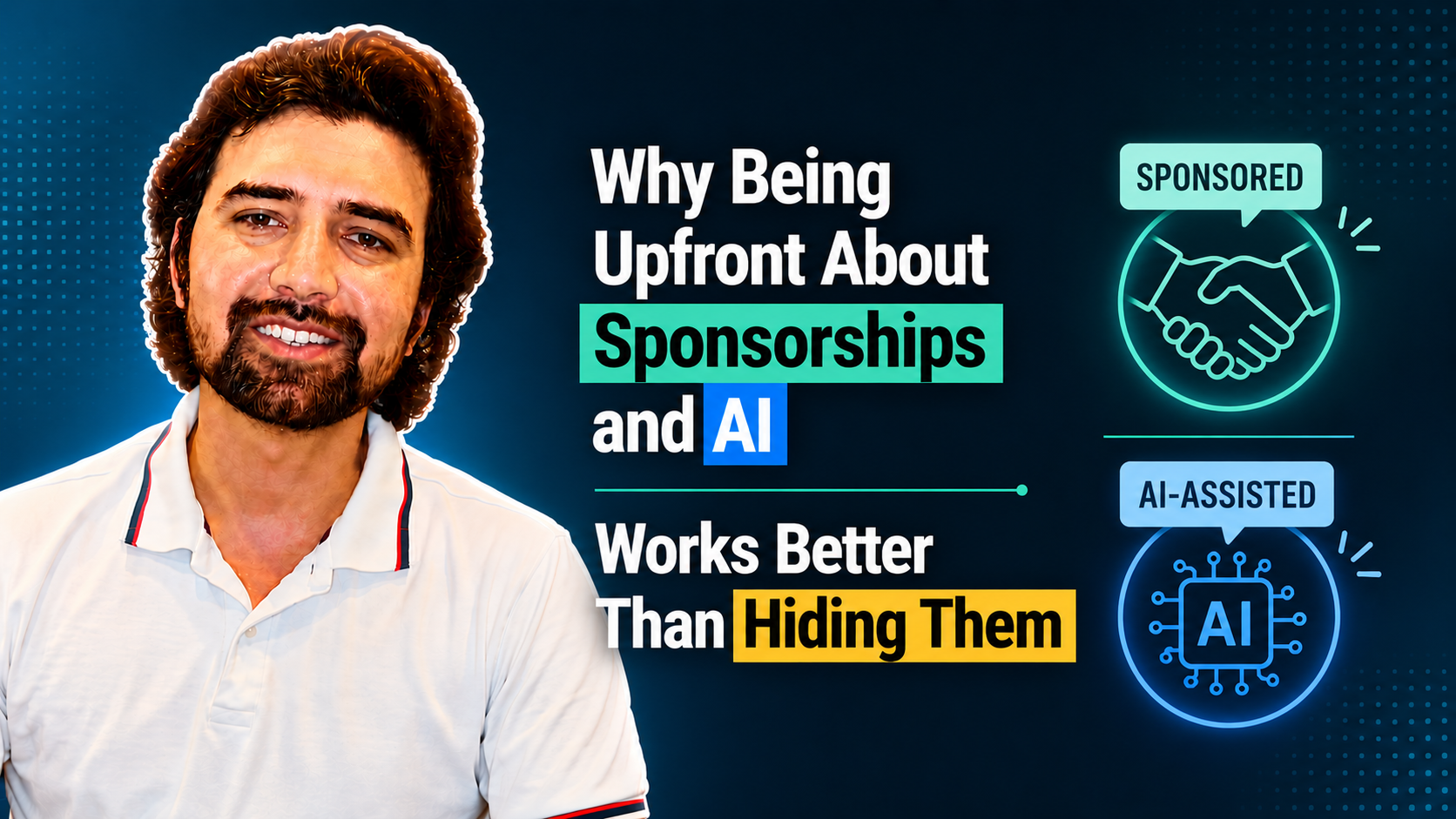
I hear a version of this worry quite often, usually from people who are good at what they do and slightly nervous about looking commercial.
It sounds like this: every time I put #ad on a post, I lose a bit of credibility. Every time I admit AI helped with something, people will value it less. So maybe keep it quiet. Put the disclosure somewhere technically present but easy to miss. Don’t bring up the tools.
I understand where that comes from, and I want to walk through why the evidence mostly points the other way.
Your audience already assumes you get paid sometimes. They assume brands approach you. They assume some kind of software is involved in your workflow, because it is involved in everybody’s workflow now. What they’re actually paying attention to, usually without thinking about it much, is whether you’re the sort of person who mentions things or the sort of person who lets them work it out on their own.
That distinction turns out to matter quite a lot, and there’s decent research behind it.
The Sponsorship Side Is Fairly Well Settled
Let’s start here, because this is where the evidence is clearest and where it surprised me a bit when I first read it.
Disclosure often helps rather than hurts
Researchers at Georgetown and Cornell ran a set of five experiments on this exact question. Participants read a fashion blogger’s post. Some saw a sponsorship disclosure attached to it, some didn’t. Everything else about the post was the same.
The people who saw the disclosure reported more trust in the blogger, not less. They rated her expertise higher, thought better of her recommendation, and also viewed the sponsoring brand more favourably.
Consumer surveys point in a similar direction. In recent polling, 59% of people said that clearly labelled sponsorships make content more trustworthy to them.
But the same survey found a few numbers sitting right next to that one, and they explain why. About 74% of respondents feel there’s too much sponsored content around, 69% say they question the motives behind sponsored material they come across, and 78% feel that a lot of modern marketing comes across as performative.
So your audience is already running a low level scepticism check over most of what they see. In that context, a clear label isn’t a cost. It’s the one element on the page that isn’t asking them to figure out the angle. You’ve done the suspicious part for them, which means they can stop doing it themselves.
The thing that actually costs you is ambiguity, not honesty.
Most of the industry is handling this badly
This part is genuinely useful for anyone building a brand right now.
The Advertising Standards Council of India studied brand promotion posts from creators on Forbes India’s Top 100 Digital Stars list. These are people with talent agencies and professional managers behind them.
69% of the posts examined were non-compliant. Only 29% carried adequate disclosure. The failures split roughly into two groups: about 57% had no disclosure label at all, and about 43% had one that was buried in a hashtag cluster or otherwise not visible without effort. Between them, these creators reach over 110 million followers.
The following year it got worse rather than better. ASCI’s report covering April 2025 to March 2026 found the violation rate within that same top 100 group had risen to 76%. Across the wider set, the regulator processed 1,609 influencer advertisements during the year and found that 97.3% required some modification.
Manisha Kapoor, who runs ASCI, made a fair point about this: these aren’t people who lack access to good advice. They have teams. The gap is a choice rather than a knowledge problem.
Which is worth sitting with if you’re a business owner or a professional building visibility online. The bar for standing out on this is currently very low. You can differentiate on basic clarity, and most of your competitors won’t.
The Rules Have Changed, Particularly in India
The trust argument is the one I care about more, but the compliance picture has shifted enough recently that it’s worth knowing.
“Material connection” covers more than money
Under ASCI’s guidelines, disclosure is triggered by any material connection between an advertiser and a creator, and this is explicitly not limited to cash payments. It includes free products (including ones you never asked for and didn’t request), discounts, gifts, contest entries, trips, and hotel stays. Anything that could reasonably shift how you talk about something.
The guidelines apply the same way whether you have a thousand followers or ten million. There’s no exemption for smaller accounts.
These also aren’t just industry preferences any more. The Central Consumer Protection Authority’s guidelines back similar requirements, and non-disclosure is increasingly treated as an unfair trade practice.
The practical rules are simple enough:
- #Ad is the reliable default. Tags like #Collab, #Gift, #Thanks and #Partnership don’t clear the bar on their own, because they’re ambiguous about whether a benefit changed hands.
- Prominent means actually visible. If someone has to tap “read more” or scroll to find it, it doesn’t count.
- Responsibility is shared. The creator makes the disclosure, and the advertiser is responsible for making sure the published content complies. If you’re a brand running campaigns, “the creator handled that” isn’t much of a defence.
AI labelling became a legal requirement in February 2026
This one hasn’t fully landed with a lot of marketers yet.
India’s Ministry of Electronics and Information Technology notified amendments to the IT Rules on 10 February 2026, which took effect on 20 February 2026. They introduce a legal category called Synthetically Generated Information, or SGI, covering audio, visual, or audio visual content that has been artificially generated or altered in a way that appears real.
What that means in practice:
- Permitted synthetic content has to be prominently labelled and carry permanent embedded provenance metadata, and platforms are specifically prohibited from allowing anyone to strip those markers out.
- Platforms with more than five million registered Indian users have to ask uploaders to declare whether content is synthetic and take technical steps to verify those declarations.
- Takedown windows for flagged unlawful content dropped from 36 hours to three.
Two details that most coverage gets wrong, so worth being precise about:
Pure text currently sits outside the SGI definition. The labelling obligation applies to audio and visual media. If you drafted a blog post with AI help, this particular rule isn’t what governs you.
Routine editing is explicitly excluded. The rules carve out good faith formatting, colour adjustment, noise reduction, compression, creating documents and templates, and using tools for accessibility, clarity, translation or discoverability. Nobody is coming after your colour grading.
The strategic point sitting underneath all that legal language is this. Once provenance metadata is embedded at the point of generation and platforms have a legal duty to verify what people declare, “nobody will find out” gradually stops being a workable assumption. The choice becomes whether you disclose on your own terms or have it surfaced for you later.
The Part That Complicates This
Now I need to tell you something that cuts against the neat version of the argument, because you should have the real picture rather than the comfortable one.
AI disclosure doesn’t behave the same way sponsorship disclosure does.
The Nuremberg Institute for Market Decisions surveyed 1,000 people each in the US, UK and Germany, then ran controlled experiments. They showed participants an identical product advertisement. Half were told it was a photograph, half were told it was AI generated.
The AI labelled version was rated lower. Less appealing, less credible, weaker emotionally, less memorable. Participants were also less willing to click through to learn more.
A second experiment using six different advertisements found the same pattern. Identical creative, only the label changed, and the AI labelled versions were judged less natural and less useful, with lower stated willingness to research or buy the product.
The researchers’ own summary was that transparency here reveals a problem without solving it. There is a measurable trust penalty attached to the AI label, and it would be dishonest of me to pretend otherwise.
The wider context explains it. In that same research, only around 20% of respondents said they trust AI itself, and 21% said they trust AI companies. So you’re not working against a mild preference. You’re working against fairly settled scepticism.
So why disclose anyway?
Three reasons, and I think they hold up.
Those studies measure the cost of disclosing. They don’t measure the cost of being found out.
Every experiment above compares a labelled version against an unlabelled one. Neither condition is “unlabelled, then identified eight months later by a customer with a good eye and a screenshot.” That third situation is the one that actually causes damage, and it’s becoming more likely as detection improves and provenance metadata becomes standard.
You’re weighing a small, contained, predictable cost against a less likely but much larger one.
Consumers are asking for labelling in fairly large numbers.
Research from Fractl, surveying just over a thousand US consumers in the second quarter of 2026, found that 84% wanted written content labelled, 91% wanted video labelled, 90% wanted images labelled, and 87% wanted audio labelled.
Against that, only 20% of organisations said they always disclose AI use, and 33% said they never do.
That’s a wide gap between expectation and practice, and gaps like that don’t usually stay open indefinitely. The same research found the share of consumers saying heavy AI use would reduce their trust in a favourite brand went from 20% to 40% in a single year.
Most of the trust penalty comes from vague labelling rather than from disclosure itself.
This is the useful one, and it deserves its own section.
The Finding That Makes This Workable
A 2026 study published in the Journal of Theoretical and Applied Electronic Commerce Research tested three versions of the same product review with 370 marketplace users. The review text was identical across all three. Only the label and the accompanying image changed.
Trust scores, measured on a five point scale:
| Condition | Consumer Trust | Perceived Authenticity |
|---|---|---|
| No AI information | 4.18 | 4.04 |
| Labelled “AI-assisted” | 3.56 | 3.35 |
| Labelled “AI-generated” | 2.30 | 2.27 |
The gap between “AI-assisted” and “AI-generated” is 1.26 points, which is larger than the gap between “AI-assisted” and no disclosure at all. Same underlying text, different words describing how it was made.
Specificity did a lot of work here. In the AI-assisted condition, the label didn’t say “AI was involved.” It said the image background had been enhanced. That precision is what protected the score.
The researchers found that perceived authenticity was the mechanism connecting the label to the trust judgment. A blanket “AI-generated” tag leaves the reader to imagine the worst case: no human involvement, no real experience, nobody accountable, nobody who actually used the product. A precise label tells them how much human is still in there.
Which gives you a practical approach with two parts.
First, reduce how much genuinely needs disclosing. If a person researched the topic, structured it, edited it, checked the facts and put their name on it, that isn’t AI generated content. It’s human work that used AI as a tool, and the research suggests audiences treat those differently.
Second, describe it accurately. Not “this post used AI,” but something closer to “drafted with AI assistance, researched and edited by me,” or “product photography is real, background extended using AI.”
The generic label is what costs you. Being specific costs almost nothing.
Google Lands in a Similar Place
Worth a quick note for anyone thinking about search visibility, because the parallel is neat.
Google’s position gets misreported constantly. It does not penalise content for being AI generated. Its stated focus is on quality and purpose rather than production method.
What it does penalise is scaled content abuse, meaning mass producing pages primarily to manipulate rankings rather than to help anyone. That policy applies identically to AI output, human output, and scraped or hybrid content. Human written spam and machine written spam get treated the same way.
The practical dividing line is human oversight and demonstrable experience. Content that a knowledgeable person reviewed, checked and shaped for a real audience tends to stay on the right side of it, whatever drafted the first version. Content generated and published in volume without review tends not to.
That’s the same principle the trust research keeps arriving at, from a different direction. The machine can help. Someone has to be accountable for the result.
A Working Approach
Here’s how I’d actually make these decisions day to day.
The question that resolves most cases
If my audience found out how this was made from somebody other than me, would they feel misled?
If yes, disclose. If genuinely no, you’re probably fine. That single test handles most real situations, and it explains why nobody needs a label for spell check but everybody needs one for a synthetic testimonial.
For sponsorships
Use #Ad, placed where it’s visible without tapping or scrolling. Disclose for gifts, barter, affiliate arrangements, free stays and unsolicited PR packages, since the trigger is benefit rather than payment. On video, say it out loud early rather than relying only on a text overlay. On stories, keep the label visible for the whole duration. And if a brand asks you to soften or hide a disclosure, that tells you something useful about the brand.
For AI
Match the wording to the actual involvement, since assisted, edited and generated describe genuinely different things. Be specific about which element was involved: the image, the first draft, the translation, the summary. Keep the disclosure near the content, worked into the byline or caption rather than sitting in a separate box at the bottom, since the research found separated disclosures tend to increase the sense of artificiality.
Don’t present anything synthetic as a real person. A chatbot labelled as a bot is fine. A chatbot given a human name and presented as a support agent is a problem waiting to surface. The same goes for synthetic testimonials, AI personas presented as real people, and generated images passed off as customer photos.
And keep real human involvement in the process, not as a gesture but because it’s what makes the disclosure survivable and, going by Google’s guidance, what keeps the content performing.
If you’re a brand running creator campaigns
Put the disclosure requirement in the contract with the exact format specified. Audit posts after they go live, since ASCI’s data shows a large share of failures involve creators who technically disclosed but did it invisibly. And remember that liability is shared, so when a creator hides a partnership, your brand name is in that file too.
What This Comes Down To
Take away the regulations and the studies and there’s something fairly ordinary underneath.
Trust doesn’t get built by looking flawless. It gets built by being predictable in one specific way, which is that your audience learns you’ll tell them things before they have to ask.
Every disclosure is a small deposit into that account. Every hidden partnership and unlabelled synthetic image is a small withdrawal, and the withdrawals tend to go unnoticed until the balance is already low.
The businesses and professionals who still have engaged audiences a few years from now probably won’t be the ones who used the least AI or took the fewest sponsorships. They’ll be the ones who were consistently upfront about both. In a market where three quarters of top creators can’t manage a visible hashtag, that’s a real position to hold.
Frequently Asked Questions
Does disclosing a sponsorship reduce engagement?
Generally not, based on the available research, and it may improve how your audience rates you. Controlled experiments found that clear disclosure increased trust in the creator and raised perceptions of their expertise. Surveys similarly find a majority say labelled sponsorships feel more trustworthy. What tends to hurt engagement is content that reads like a hidden advertisement, which is a different issue.
Do I have to disclose free products I never asked for?
Yes. ASCI’s definition of material connection includes unsolicited gifts and free products, along with discounts, trips, hotel stays and contest entries. The test is whether a reasonable person would want to know before weighing your opinion.
Is #Collab or #Partnership enough?
No. Those terms leave it unclear whether any benefit changed hands. #Ad is the recognised standard. Placement matters as much as wording, so a disclosure hidden inside a hashtag block or behind a “read more” link doesn’t meet the prominence requirement.
Do I legally have to label AI-written blog posts in India?
Under the February 2026 IT Rules amendments, the labelling obligation applies to audio, visual and audio visual content. Pure text currently falls outside that definition, while synthetic images, video and voice used in marketing do fall within scope. The legal minimum and the trust building standard aren’t the same thing, and this area is still developing, so check the current position before relying on it.
Won’t labelling content as AI just make people trust it less?
Sometimes, and that’s a real finding worth respecting. But the penalty concentrates heavily in vague, blanket “AI-generated” labels. In controlled testing, precise “AI-assisted” labelling scored much higher, closing most of the gap. Keep real human involvement in the process, then describe that involvement accurately.
Does Google penalise AI-generated content?
No. Google evaluates quality and purpose rather than production method. What gets penalised is scaled content abuse, meaning mass producing low value pages to manipulate rankings, and that applies equally to human and AI production. Human review, fact checking and genuine first hand experience are what keep content on the right side of it.
Who’s responsible if a creator doesn’t disclose, the brand or the creator?
Both. Under ASCI’s framework the creator makes the disclosure, while the advertiser is responsible for ensuring the published content complies and for requiring corrections where it doesn’t.
Where It Gets Tricky in Practice
All of the above is straightforward as a principle and considerably less straightforward as a set of daily decisions.
Do you label the AI upscaled hero image on your landing page? How do you word a disclosure on a Reel without losing people in the first three seconds? What goes into your creator contracts so that a partner’s shortcut doesn’t become your regulatory problem? How do you keep a recognisable human voice in your content when the volume expectations keep rising?
There aren’t universal answers to those. It depends on your category, how sceptical your audience already is, how much of your business runs on trust, and what you can realistically sustain.
That’s the kind of work I do with clients, building content and social media programmes that are transparent by design rather than transparent after something goes wrong. In my experience it usually turns out to be less restrictive than people expect and more effective than the alternative, because trust builds up over time in a way that reach on its own doesn’t.
If you’re weighing these decisions for your own business or practice, or you’ve looked back over your last few months of content and felt slightly uneasy about a couple of pieces, that’s worth talking through properly.
Click here and tell me what you’re working on
No pitch deck and no retainer conversation on the first call. Just a look at where your content sits now and what a more durable version would involve.
This article is for informational purposes only and shouldn’t be treated as legal or compliance advice.
Deepak Vankar is a digital marketing consultant working with businesses and professionals on SEO, content, performance marketing and brand strategy.
Leave a Reply